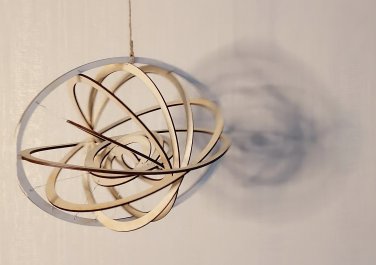
Reconstruction.
Rodchenko Spatial construction Oval within a Oval No. 12 (Oval in a Oval )
From the series of spatial constructions “Surfaces that reflect light” (series of "Light-Reflecting Surfaces" [Ploskosti otrazhaiushchie svet]) 1920-1921
These constructions are in response to a request to make the Spatial Construction’s of Alexandre Rodchenko available to the public and to allow for an understanding of how pure his work was.
Composed of ovals that nest and intersect, Spatial Construction no. 12 hangs suspended, moving slowly with any current of air. The ovals were measured out on a single flat sheet of plywood, precisely cut, then rotated within each other to make a three-dimensional object. The resulting form suggests a chart of planetary orbits, a cosmic structure. In companion pieces, Rodchenko applied the same principle and method to other basic geometric shapes, such as the square.
Rodchenko's interest in mathematical systems reflects the scientific bent of the Russian Constructivists, artists who aspired to create a radically new, radically rational art for the society that came into being with the Russian Revolution. Spatial Construction no. 12 is a stage in Rodchenko’s progress away from conventional painting and toward an art taking place in space — ultimately, an art of social involvement. The work has no clear top or bottom, and no base to rest on. It is virtually weightless, with suspension and movement replacing mass. In short, it was designed to be everything traditional sculpture was not — to reimagine art from ground zero. The artist later reflected, “We created a new understanding of beauty, and enlarged the concept of art.”
From 1918 through 1921, Rodchenko made three series of Spatial Constructions, each comprised of six works. Regrettably, most of them have long been known only through photographs made at the time and through Rodchenko's own sketches on a page of his notebook. The sole surviving work is Spatial Construction no. 12 of about 1920.
Rodchenko imposed a simple logic upon his method of construction. Made of light plywood, each work was restricted to a single geometric shape, cut in concentric bands of regular width and painted silver to reflect the light. When flat, each sculpture was a unitary form: an oval, a circle, a triangle, a square, a hexagon, and an octagon. Suspended from the ceiling instead of placed on a traditional pedestal, the sculpture fanned out into space, articulating a complex volume whose shadow was still more complex and variable.
One of the most versatile Constructivist and Productivist artists to emerge after the Russian Revolution, Aleksandr Rodchenko worked as a painter, graphic designer, photographer, photomontageist, architectural designer, and sculptor. He was alternately influenced by Suprematism, Productivism, Dada, Constructivism, Abstraction, and Abstract Expressionism--working in different modes throughout his artistic life.
Dimensions
11.5 x 8 x 7" (30 x 20 x 18 cm)
Thanks for looking!